<?xml version="1.0" encoding="utf-8"?>
<feed xmlns="http://www.w3.org/2005/Atom"><title>Dilip's Log: denden</title><subtitle>Posts tagged denden on Dilip's Log</subtitle><link rel="alternate" type="text/html" href="https://idlip.in/" /><link rel="self" type="application/atom+xml" href="https://idlip.in/rss.xml" /><id>https://idlip.in/</id><updated>2026-11-20T00:00:00Z</updated><author><name>Dilip | Zororg</name><email>hi@idlip.in</email></author><generator uri="https://gohugo.io/">Hugo</generator><rights>Copyright © 2023-2026, Dilip | Zororg; All rights reserved.</rights><entry><title>Remaking the site: Hakimacs to Kenbun</title><link rel="alternate" type="text/html" href="https://idlip.in/log/remake-kenbun/" /><id>https://idlip.in/log/remake-kenbun/</id><published>2026-11-19T00:00:00Z</published><updated>2026-11-20T00:00:00Z</updated><category term="denden" label="denden" scheme="https://idlip.in/tags/"></category><category term="webdev" label="webdev" scheme="https://idlip.in/tags/"></category><content type="html"><![CDATA[<p>
In January I wrote about <a href="/log/revamp-blog-2026/">Revamp the blogs</a> and in march about <a href="/log/emacs-theme-site/">Replenish theme - its Emacsy</a>. Now, here we go once more. <i>Same same, but really different</i>
</p>

<p>
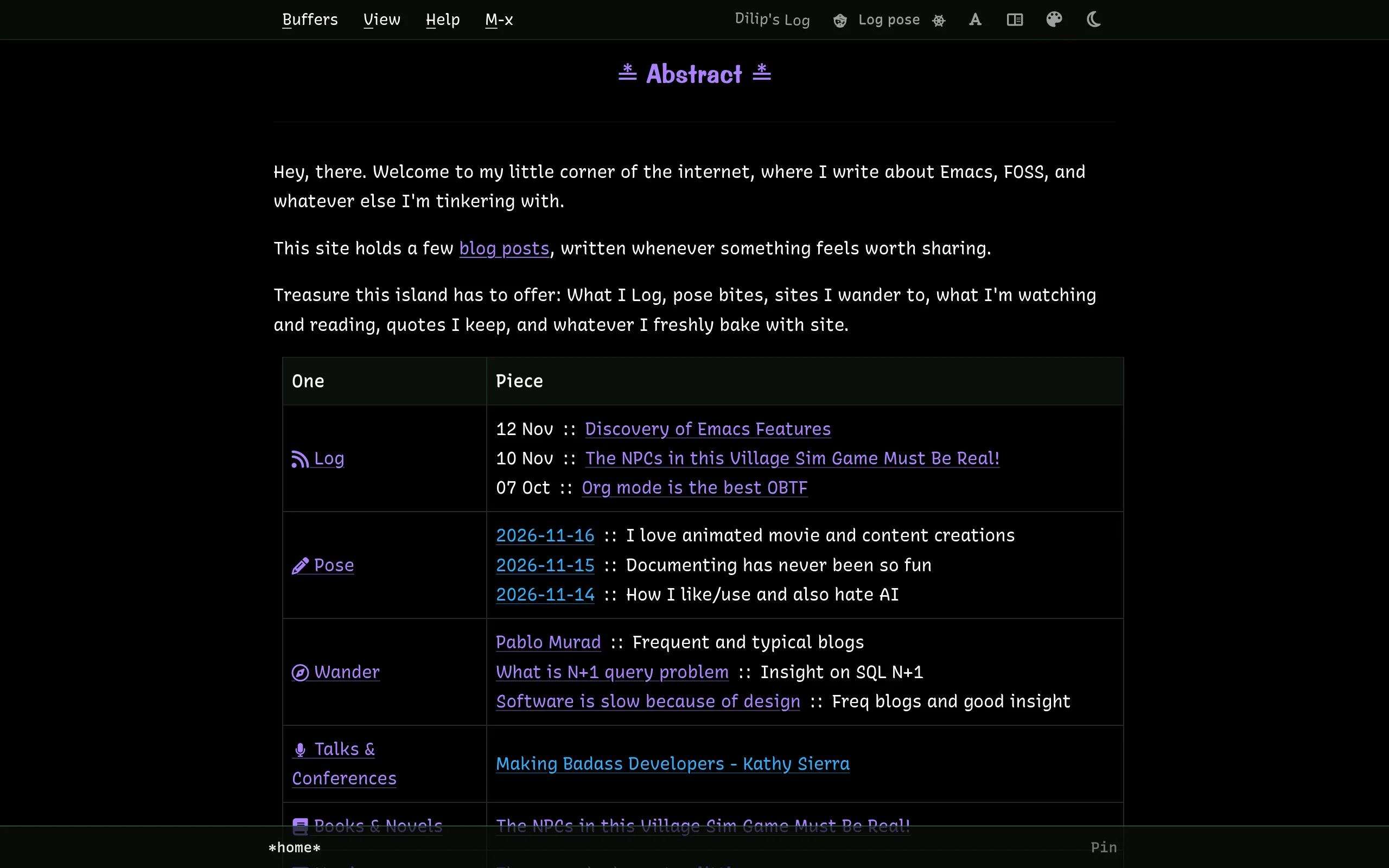
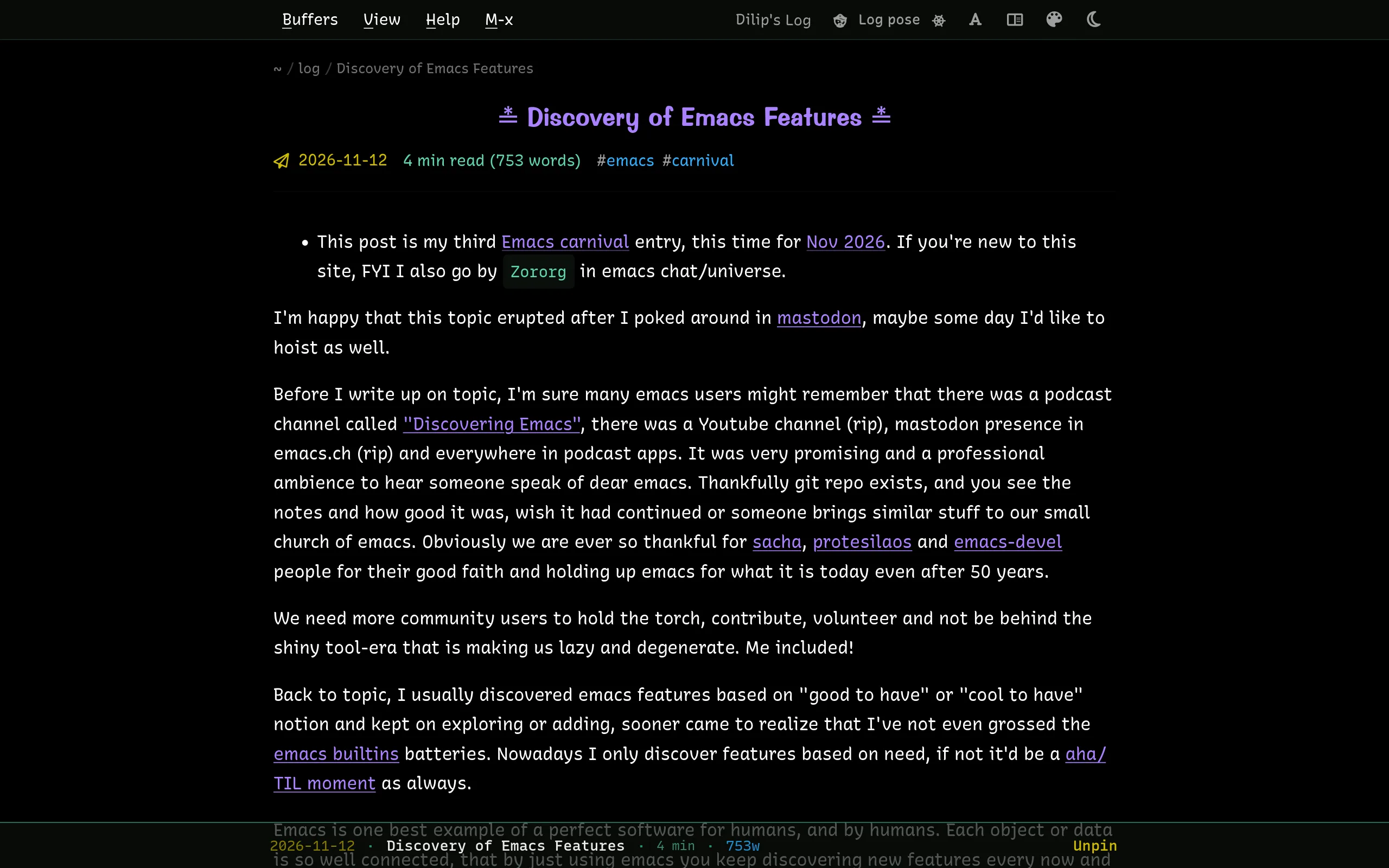
The old look, <i>Hakimacs</i>, painted every page as an Emacs window: a menu bar on top, a modeline at the bottom, an echo area, dropdowns, frosted glass. I loved how it looked. But over time I kept adding "helpers for reading" and now the helpers look noisier than the reading. I like how <a href="https://bearblog.dev/">Bear Blog</a>, Miniflux <a href="https://lobste.rs/">Lobsters</a> just let you read, with no BS. So this time the rule was simple: the page exists to be read, and the CSS exists to be maintained.
</p>

<p>
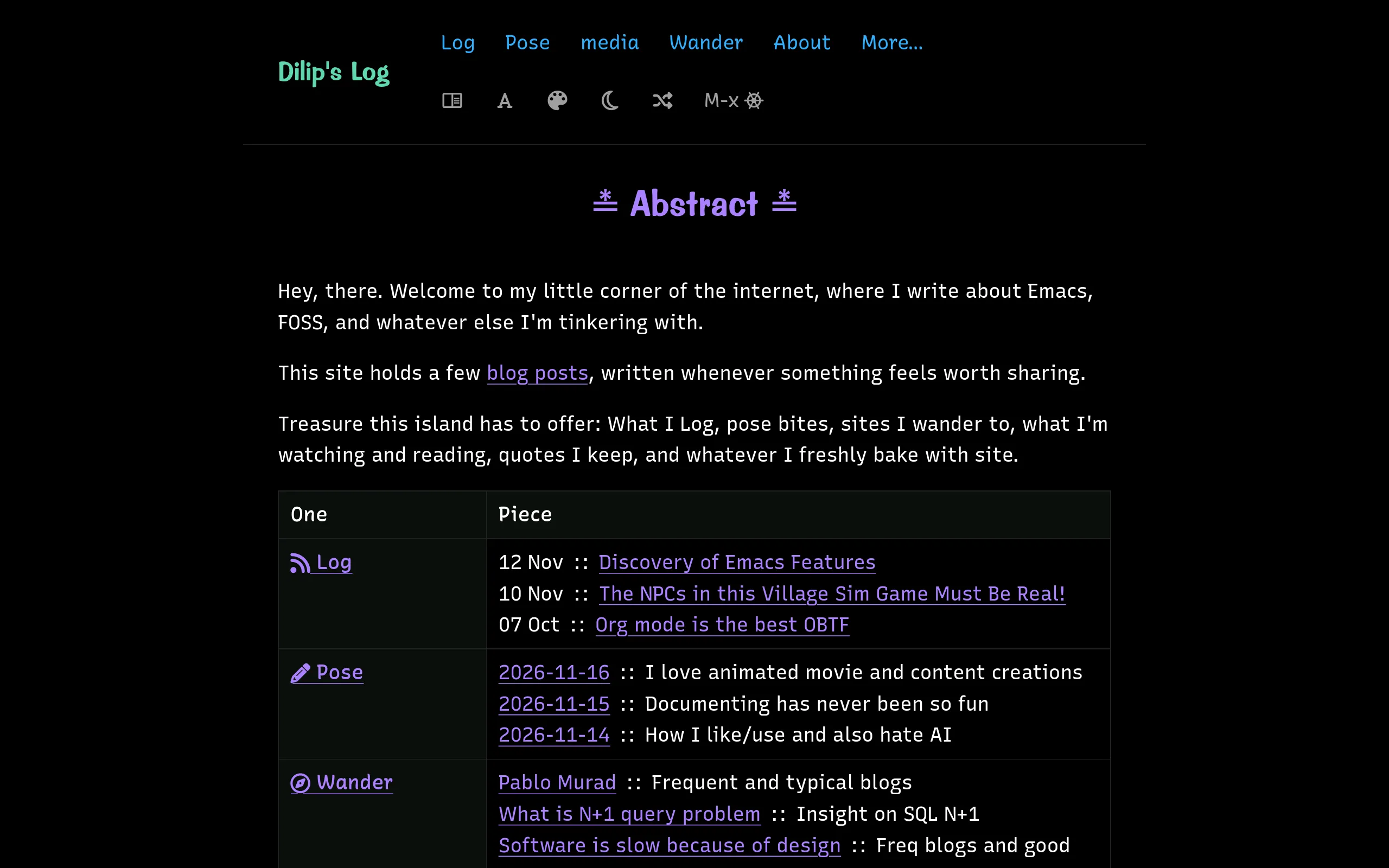
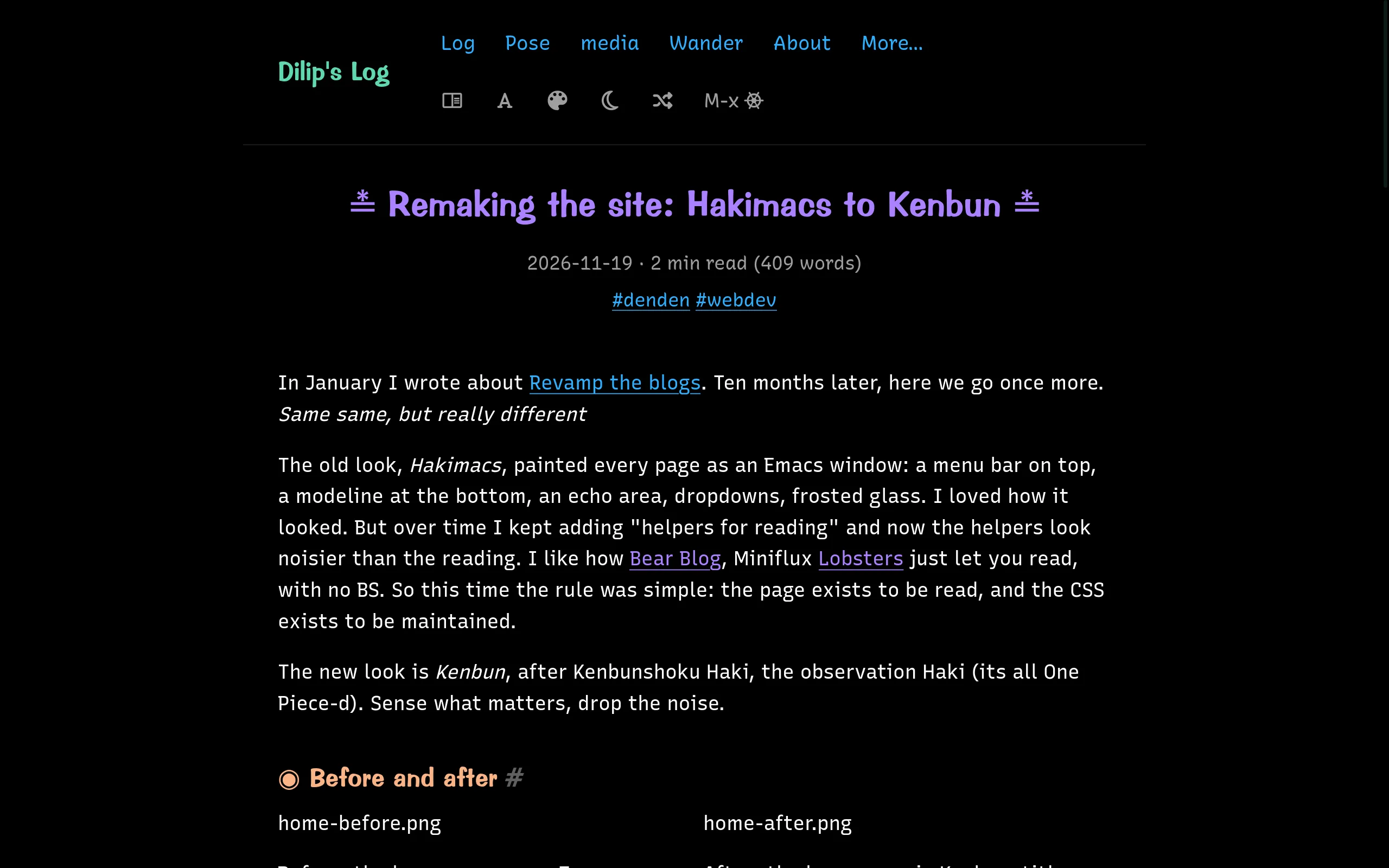
The new look is <i>Kenbun</i>, named after <a href="https://onepiece.fandom.com/wiki/Haki/Observation_Haki">Kenbunshoku Haki</a>, the observation Haki (its all One Piece-d). Sense what matters, drop the noise.
</p>
<div id="outline-container-before-and-after" class="outline-2">
<h2 id="before-and-after">Before and after<a class="heading-anchor" href="#before-and-after" aria-label="Link to this section">#</a></h2>
<div class="outline-text-2" id="text-org4c6aa5b">
<div class="grid" id="org1f04dc5">

<div id="org407f1fc" class="figure">
<p><img src="/images/kenbun/hakimacs-home.webp" alt="hakimacs-home.webp" />
</p>
<p>Before: the home page as an Emacs window, with menu bar and modeline</p>
</div>


<div id="org7a3c95d" class="figure">
<p><img src="/images/kenbun/home.webp" alt="home.webp" />
</p>
<p>After: the home page in Kenbun, title, links and a plain column</p>
</div>

</div>

<div class="grid" id="org8888596">

<div id="org7015d79" class="figure">
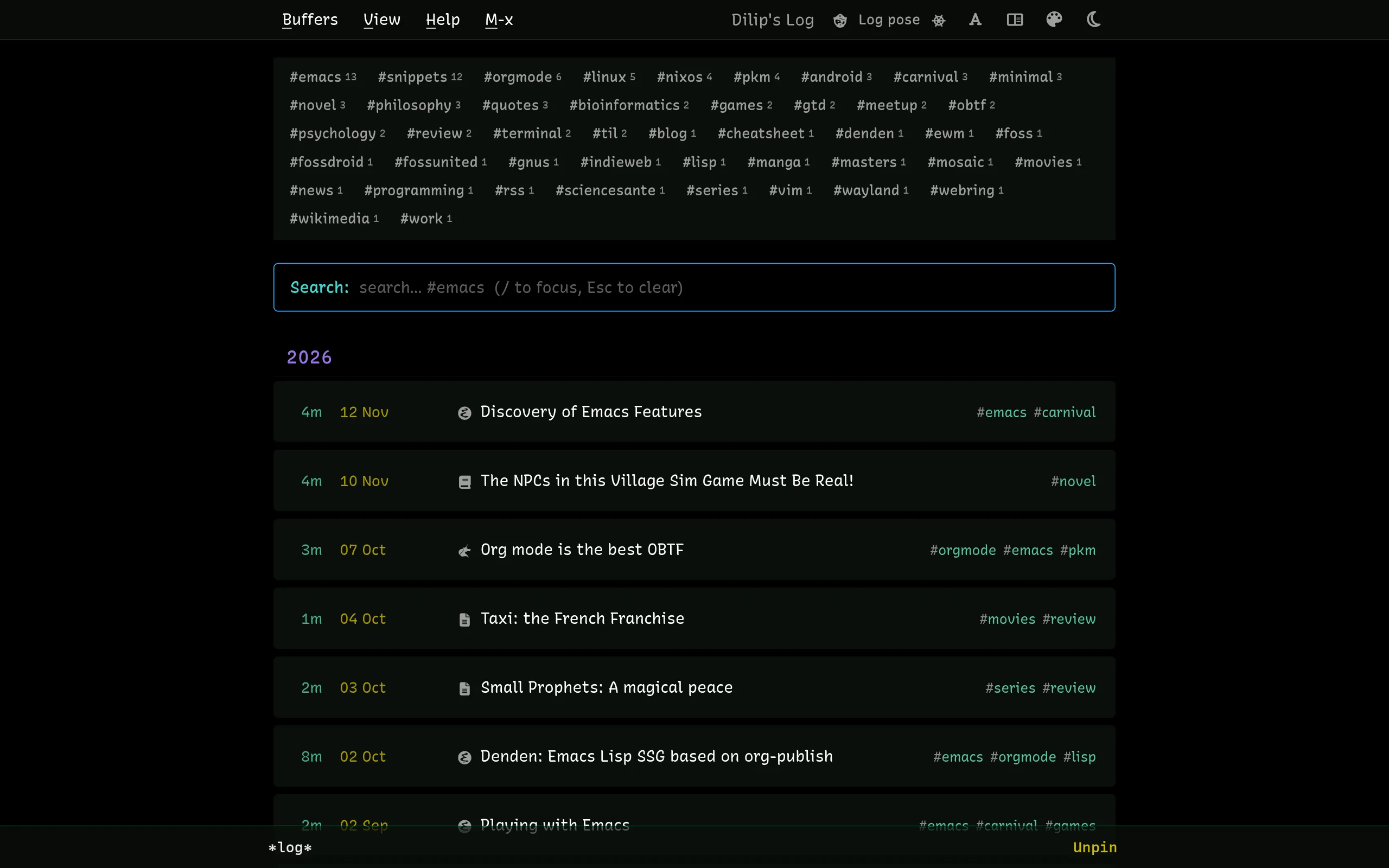
<p><img src="/images/kenbun/hakimacs-list.webp" alt="hakimacs-list.webp" />
</p>
<p>Before: the posts listing page</p>
</div>


<div id="org273b4c5" class="figure">
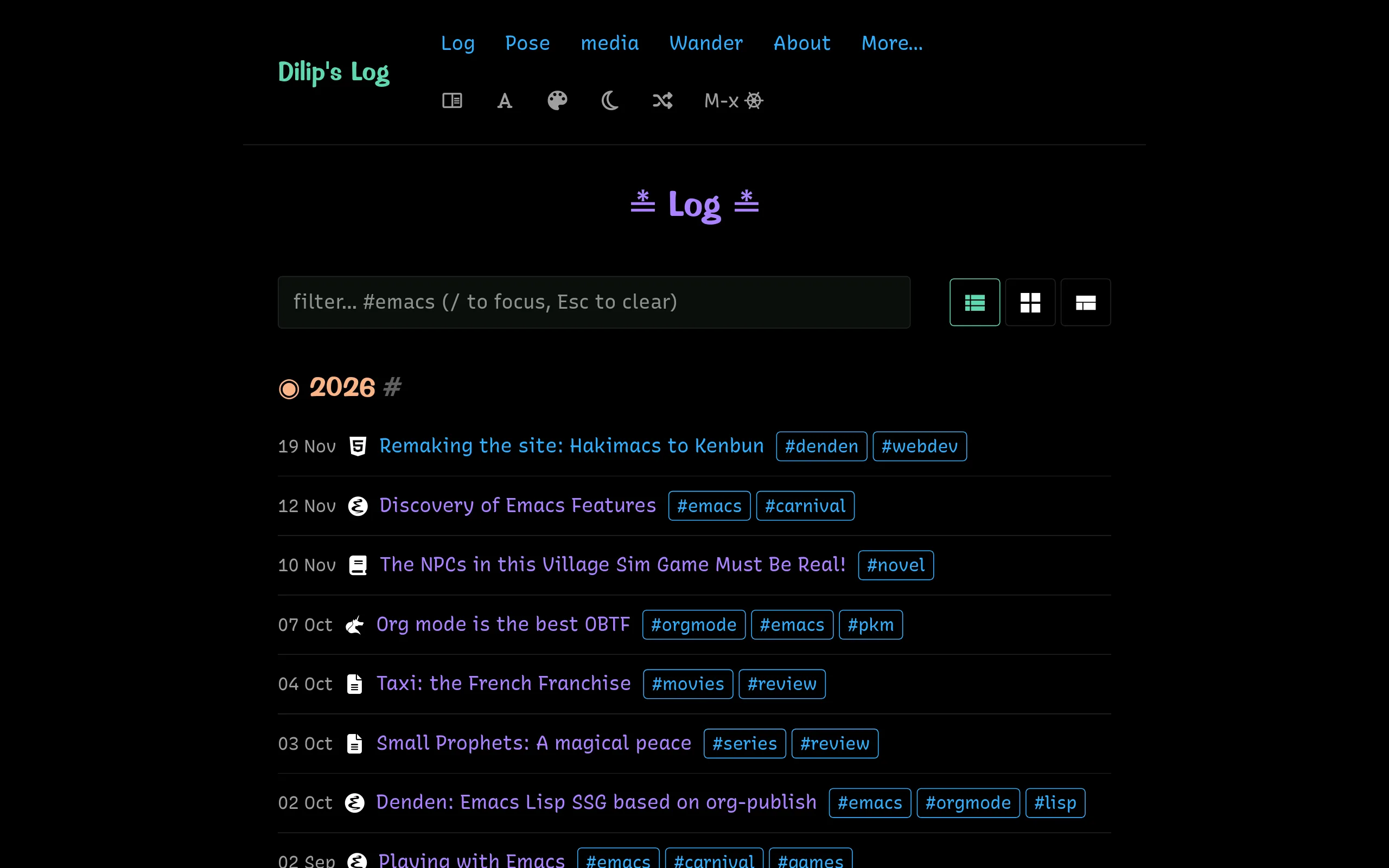
<p><img src="/images/kenbun/list.webp" alt="list.webp" />
</p>
<p>After: the new simple listing page</p>
</div>

</div>


<div class="grid" id="orgbe18b68">

<div id="orge899ab5" class="figure">
<p><img src="/images/kenbun/hakimacs-post.webp" alt="hakimacs-post.webp" />
</p>
<p>Before: a post inside the Emacs frame</p>
</div>


<div id="org28c0182" class="figure">
<p><img src="/images/kenbun/post.webp" alt="post.webp" />
</p>
<p>After: the same post, just the words</p>
</div>

</div>
</div>
</div>
<div id="outline-container-what-went" class="outline-2">
<h2 id="what-went">What went<a class="heading-anchor" href="#what-went" aria-label="Link to this section">#</a></h2>
<div class="outline-text-2" id="text-orgd9fb720">
<ul class="org-ul">
<li>The fake Emacs frame: menu bar, modeline, echo area, hamburger menu.</li>
<li>Breadcrumbs, the reading progress bar, sidenotes, code copy buttons, the image lightbox.</li>
<li>A random colour scheme on every visit, the themes gallery, and the rain confetti on badges.</li>
</ul>
</div>
</div>
<div id="outline-container-what-stayed-because-i-want-it" class="outline-2">
<h2 id="what-stayed-because-i-want-it">What stayed, because I want it<a class="heading-anchor" href="#what-stayed-because-i-want-it" aria-label="Link to this section">#</a></h2>
<div class="outline-text-2" id="text-org5075895">
<ul class="org-ul">
<li>My fonts, the heading glyphs, and the five font modes.</li>
<li>base16 colour schemes, with Haki as the default.</li>
<li>The command palette with its glass blur, one place to search and navigate everything.</li>
<li>The spinning glow on hover, the badges, and the WANTED poster on the 404 page.</li>
</ul>
</div>
</div>
<div id="outline-container-by-the-numbers" class="outline-2">
<h2 id="by-the-numbers">By the numbers<a class="heading-anchor" href="#by-the-numbers" aria-label="Link to this section">#</a></h2>
<div class="outline-text-2" id="text-org78a5a9e">
<table border="2" cellspacing="0" cellpadding="6" rules="groups" frame="hsides">


<colgroup>
<col  class="org-left" />

<col  class="org-right" />

<col  class="org-right" />
</colgroup>
<thead>
<tr>
<th scope="col" class="org-left">File</th>
<th scope="col" class="org-right">Before</th>
<th scope="col" class="org-right">After</th>
</tr>
</thead>
<tbody>
<tr>
<td class="org-left"><code>theme.css</code></td>
<td class="org-right">3365</td>
<td class="org-right">915</td>
</tr>

<tr>
<td class="org-left"><code>index.js</code></td>
<td class="org-right">1436</td>
<td class="org-right">822</td>
</tr>

<tr>
<td class="org-left"><code>theme.el</code></td>
<td class="org-right">1219</td>
<td class="org-right">565</td>
</tr>
</tbody>
</table>
</div>
</div>
<div id="outline-container-what-i-kept-in-mind" class="outline-2">
<h2 id="what-i-kept-in-mind">What I kept in mind<a class="heading-anchor" href="#what-i-kept-in-mind" aria-label="Link to this section">#</a></h2>
<div class="outline-text-2" id="text-org69395f2">
<ul class="org-ul">
<li>Style plain HTML elements first, and keep a short list of shared pieces. A new page reuses them; it
never gets its own CSS.</li>
<li>Trust the browser: <code>&lt;details&gt;</code> for folding, <code>&lt;dialog&gt;</code> for the palette, a popover for small notes.</li>
<li>Readable or gone. Every colour scheme is checked for contrast when the site is built, and only 140 pass AAA out of 306 schemes.</li>
</ul>

<p>
<i>Read more, write more, give more</i>
</p>
</div>
</div>
]]></content></entry><entry><title>Denden: Emacs Lisp SSG based on org-publish</title><link rel="alternate" type="text/html" href="https://idlip.in/log/denden/" /><id>https://idlip.in/log/denden/</id><published>2026-10-02T00:00:00Z</published><updated>2026-10-06T00:00:00Z</updated><category term="emacs" label="emacs" scheme="https://idlip.in/tags/"></category><category term="orgmode" label="orgmode" scheme="https://idlip.in/tags/"></category><category term="lisp" label="lisp" scheme="https://idlip.in/tags/"></category><category term="denden" label="denden" scheme="https://idlip.in/tags/"></category><content type="html"><![CDATA[<p>
<a href="https://github.com/idlip/denden">Denden</a> is yet another SSG based on org-publish and utilizing complete Elisp ecosystem. This site is
built using that. Its not a package per-say, just an helper and building blocks on top of org mode's
native <a href="https://orgmode.org/manual/Publishing.html">ox-publish</a> and <a href="https://orgmode.org/worg/dev/org-element-api.html">org-element</a> for AST.
</p>
<div id="outline-container-why-i-even-started-this" class="outline-2">
<h2 id="why-i-even-started-this">Why I even started this<a class="heading-anchor" href="#why-i-even-started-this" aria-label="Link to this section">#</a></h2>
<div class="outline-text-2" id="text-orgb23f767">
<p>
This site used to run on <a href="https://gohugo.io">Hugo</a> using same theme called <a href="https://github.com/idlip/hakimacs">hakimacs</a>, with content in Org mode rendered through go-org, and it worked fine for months. But I hated looking how ugly <a href="https://gohugo.io/templates/introduction/">go-template</a> looked and lot of regexp to do something, although it was fast, it was not human (emacs user) friendly to read at all. When I wrote in org mode, I always liked why not elisp somewhere to hack and do stuff. Org is a rich ecosystem and it needs way more hackable place to configure, not hugo to regexp parse everything.
</p>

<p>
Org has a perfectly good parser living right inside Emacs, <code>org-element</code>, that turns any <code>.org</code> file into a proper tree I can walk, query, and reshape however I like. So the question became obvious, why am I throwing that tree away and going back to regexing strings, when the real structure is sitting right there the whole time.
</p>

<p>
That annoyance is the entire reason denden exists.
</p>
</div>
</div>
<div id="outline-container-what-denden-actually-is-and-isn-t" class="outline-2">
<h2 id="what-denden-actually-is-and-isn-t">What denden actually is, and isn't<a class="heading-anchor" href="#what-denden-actually-is-and-isn-t" aria-label="Link to this section">#</a></h2>
<div class="outline-text-2" id="text-org651efe3">
<p>
<code>denden</code> is not a package, its more like a tool, helpers and building block on top of org-publish. It
uses all native org mode libs and <code>org-publish</code>, the publishing engine that already ships inside Org mode, plus a small pile of Elisp helper functions sitting on top of it, that's the whole thing. <code>denden.el</code> itself is one file, no hidden layers, no magic you can't just <code>M-x describe-function</code> your way into.
</p>

<div class="org-src-container">
<pre class="src src-emacs-lisp"><code><span class="org-comment-delimiter">;; </span><span class="org-comment">this is roughly the entire mental model
</span>(<span class="org-keyword">require</span> '<span class="org-constant">denden</span>)
(<span class="org-keyword">setq</span> denden-content-directory <span class="org-string">"~/my-site/content"</span>)
(<span class="org-keyword">setq</span> denden-publishing-directory <span class="org-string">"~/my-site/public"</span>)
(<span class="org-keyword">setq</span> denden-full-build-function #'my-site-build)
<span class="org-comment-delimiter">;; </span><span class="org-comment">now M-x denden-build just works</span>
</code></pre>
</div>

<p>
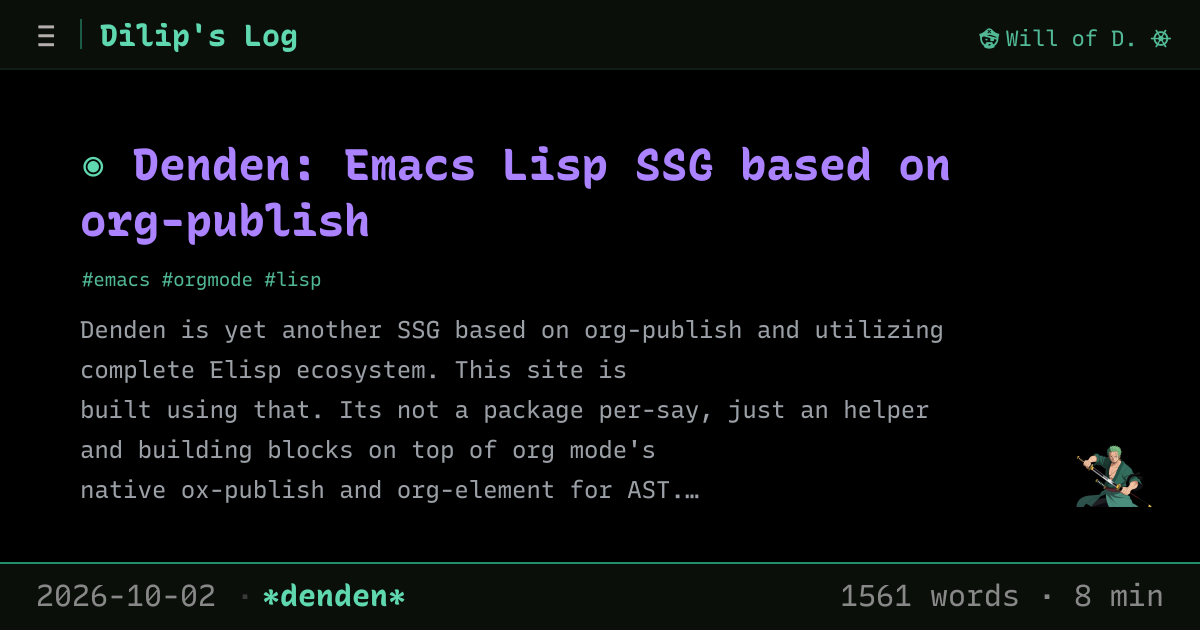
Everything else, <a href="/rss.xml">feeds</a>, <a href="/sitemap.xml">sitemap</a>, search index, <a href="/og/denden.png">OG card images</a>, the accessibility linter, is a
building block you call when you want it, not a framework deciding things for you. If you don't like
how I did sitemaps, you just don't call <code>denden-sitemap-xml</code>, and write your own three lines instead.
Nobody's stopping you, there's no true "denden way" to acheive it.
</p>
</div>
</div>
<div id="outline-container-templates-are-just-lists-the-sexp-html-bit" class="outline-2">
<h2 id="templates-are-just-lists-the-sexp-html-bit">Templates are just lists, the sexp-HTML bit<a class="heading-anchor" href="#templates-are-just-lists-the-sexp-html-bit" aria-label="Link to this section">#</a></h2>
<div class="outline-text-2" id="text-org7c075a8">
<p>
This is the part I like the most, a denden template is not a template language at all, it's a plain Emacs Lisp list, shaped like this.
</p>

<div class="org-src-container">
<pre class="src src-emacs-lisp"><code>(TAG ATTRIBUTE-PLIST . CHILDREN)
</code></pre>
</div>

<p>
A tag symbol, a plist of attributes, then however many children you want, which can themselves be more nodes or plain strings. Something this small turns into real HTML.
</p>

<div class="org-src-container">
<pre class="src src-emacs-lisp"><code>(list 'div '(<span class="org-builtin">:class</span> <span class="org-string">"card"</span>)
      (list 'h2 nil <span class="org-string">"Hello"</span>)
      (list 'p '(<span class="org-builtin">:class</span> <span class="org-string">"muted"</span>) <span class="org-string">"Written as a list, not a string template."</span>))
<span class="org-comment-delimiter">;; </span><span class="org-comment">C-x C-e =&gt; (div (:class "card") (h2 nil "Hello") (p (:class "muted") "Written as a list, not a string template."))</span>
</code></pre>
</div>

<p>
Run that through <code>denden-serialize-node</code> and you get.
</p>

<div class="org-src-container">
<pre class="src src-html"><code>&lt;<span class="org-function-name">div</span> <span class="org-variable-name">class</span>=<span class="org-string">"card"</span>&gt;&lt;<span class="org-function-name">h2</span>&gt;<span class="org-underline"><span class="org-bold-italic">Hello</span></span>&lt;/<span class="org-function-name">h2</span>&gt;&lt;<span class="org-function-name">p</span> <span class="org-variable-name">class</span>=<span class="org-string">"muted"</span>&gt;Written as a list, not a string template.&lt;/<span class="org-function-name">p</span>&gt;&lt;/<span class="org-function-name">div</span>&gt;
</code></pre>
</div>

<p>
No Jinja-style <code>&lt;% if %&gt;</code> tags, no template DSL to look up in some docs page, it's Lisp, so it's just Lisp. If you need a loop you use <code>mapcar</code>, if you need a condition you use <code>if</code>, you already know how, because you already know Emacs Lisp, or you're learning it anyway for your config.
</p>

<p>
Here's a tiny real one, lifted straight from denden's own example site, <code>denden/example/example-theme.el</code>, the page header.
</p>

<div class="org-src-container">
<pre class="src src-emacs-lisp"><code>(<span class="org-keyword">cl-defun</span> <span class="org-function-name">example-theme-header</span> (<span class="org-type">&amp;key</span> site-title menu-items)
  <span class="org-doc">"The page header: SITE-TITLE linking home, then a MENU-ITEMS nav."</span>
  (list 'header nil
        (list 'a '(<span class="org-builtin">:class</span> <span class="org-string">"title"</span> <span class="org-builtin">:href</span> <span class="org-string">"/"</span>)
              (list 'h2 nil site-title))
        (append (list 'nav nil)
                (mapcar (<span class="org-keyword">lambda</span> (item) (list 'a (list <span class="org-builtin">:href</span> (cdr item)) (car item)))
                        menu-items))))
</code></pre>
</div>

<p>
That's a whole working nav bar, <code>menu-items</code> is just a list of <code>(label . url)</code> pairs. Add a link to your site, add one more cons cell, no shortcode, no registering a new partial, nothing to restart.
</p>
</div>
</div>
<div id="outline-container-how-my-own-site-is-built-with-it" class="outline-2">
<h2 id="how-my-own-site-is-built-with-it">How my own site is built with it<a class="heading-anchor" href="#how-my-own-site-is-built-with-it" aria-label="Link to this section">#</a></h2>
<div class="outline-text-2" id="text-org60036c3">
<p>
My site's own Elisp lives in exactly three files, and I think that's a feature, not something I need to apologize for.
</p>

<ul class="org-ul">
<li><code>denden/denden.el</code> : the generic core engine, nothing specific to my site at all.</li>
<li><code>site/site.el</code> : my config and page logic, menu items, badges, feed setup, everything that's <i>my</i> data.</li>
<li><code>theme/theme.el</code> : my actual sexp-HTML templates.</li>
</ul>

<p>
Config is just Elisp data, so it looks like this, shortened from my real <code>site.el</code>.
</p>

<div class="org-src-container">
<pre class="src src-emacs-lisp"><code>(<span class="org-keyword">defconst</span> <span class="org-variable-name">site-menu-main</span>
  '((<span class="org-builtin">:name</span> <span class="org-string">"Home"</span> <span class="org-builtin">:url</span> <span class="org-string">"/"</span>)
    (<span class="org-builtin">:name</span> <span class="org-string">"Blog Posts"</span> <span class="org-builtin">:url</span> <span class="org-string">"/log/"</span>)
    (<span class="org-builtin">:name</span> <span class="org-string">"Wander My Small Web"</span> <span class="org-builtin">:url</span> <span class="org-string">"/wander/"</span>)
    (<span class="org-builtin">:name</span> <span class="org-string">"Media"</span> <span class="org-builtin">:url</span> <span class="org-string">"/media/"</span>)
    (<span class="org-builtin">:name</span> <span class="org-string">"Quotes"</span> <span class="org-builtin">:url</span> <span class="org-string">"/quotes/"</span>)))
</code></pre>
</div>

<p>
Want another nav item, add a line. Want a new badge on my footer, same deal, it's one more plist in a list, no new file, no new template syntax to learn.
</p>

<p>
Everything you're reading right now, the  <button type="button" class="tag-cloud-btn" data-action="open-palette">Command palette</button>, the <button type="button" class="tag-cloud-btn" data-action="browse-schemes">colour scheme picker with 305 base16 themes</button>, the <a href="/wander/">Wander My Small Web</a>, the <a href="/pose/">Pose | Vivre Card</a> quick-thought cards, the accessible dialogs, all of that is just more sexp nodes and a bit of plain JS, sitting on top of the same three files.
</p>
</div>
</div>
<div id="outline-container-one-more-cool-bit-even-the-og-card-images-are-sexp" class="outline-2">
<h2 id="one-more-cool-bit-even-the-og-card-images-are-sexp">One more cool bit, even the OG card images are sexp<a class="heading-anchor" href="#one-more-cool-bit-even-the-og-card-images-are-sexp" aria-label="Link to this section">#</a></h2>
<div class="outline-text-2" id="text-org4122475">
<p>
OG cards, the preview image you see when a link gets shared on social media, are usually generated with some headless browser screenshot setup or an image library. In denden it's the exact same <code>(TAG ATTRIBUTE-PLIST . CHILDREN)</code> trick, just aimed at <code>&lt;svg&gt;</code> instead of <code>&lt;div&gt;</code>, from my own <code>site.el</code>.
</p>

<p>
I know IK, by now you might realize and say this is hard to write as well, but thats the cool stuff.
Own it in lisp way. Direct maintenance of HTML files with no system is also cool tho ;-)
</p>

<div class="org-src-container">
<pre class="src src-emacs-lisp"><code>(list 'svg (list <span class="org-builtin">:xmlns</span> <span class="org-string">"http://www.w3.org/2000/svg"</span> <span class="org-builtin">:viewBox</span> <span class="org-string">"0 0 1200 630"</span>
                  <span class="org-builtin">:width</span> <span class="org-string">"1200"</span> <span class="org-builtin">:height</span> <span class="org-string">"630"</span> <span class="org-builtin">:font-family</span> <span class="org-string">"Code D OnePiece, monospace"</span>)
      (list 'rect '(<span class="org-builtin">:width</span> <span class="org-string">"1200"</span> <span class="org-builtin">:height</span> <span class="org-string">"630"</span> <span class="org-builtin">:fill</span> <span class="org-string">"#000000"</span>))
      (list 'rect '(<span class="org-builtin">:width</span> <span class="org-string">"1200"</span> <span class="org-builtin">:height</span> <span class="org-string">"68"</span> <span class="org-builtin">:fill</span> <span class="org-string">"#0a0f0a"</span>))
      (list 'text '(<span class="org-builtin">:x</span> <span class="org-string">"100"</span> <span class="org-builtin">:y</span> <span class="org-string">"46"</span> <span class="org-builtin">:fill</span> <span class="org-string">"#5fd7af"</span> <span class="org-builtin">:font-size</span> <span class="org-string">"30"</span> <span class="org-builtin">:font-weight</span> <span class="org-string">"bold"</span>)
            card-site-title)
      <span class="org-comment-delimiter">;; </span><span class="org-comment">... and so on, title lines, tags, excerpt, favicon, all the same nodes
</span>      )
</code></pre>
</div>

<p>
Same <code>denden-serialize-node</code> (<a href="https://github.com/idlip/denden/blob/master/denden.el">check file</a>) call at the end, except this time the string it hands back is an SVG file sitting at <code>/log/some-post/og.svg</code>. No separate image-generation step, no Canva template, just more rects and text nodes.
</p>
</div>
</div>
<div id="outline-container-it-s-also-properly-fast" class="outline-2">
<h2 id="it-s-also-properly-fast">It's also properly fast<a class="heading-anchor" href="#it-s-also-properly-fast" aria-label="Link to this section">#</a></h2>
<div class="outline-text-2" id="text-org09dfd11">
<p>
I was bracing for a slow first build, since Emacs isn't exactly famous for being a speed train. It wasn't. A full build of this entire site, every post, every feed, every OG card image, finishes in a couple of seconds. I build it from the terminal like this.
</p>

<div class="org-src-container">
<pre class="src src-sh"><code>emacs --batch -Q -L denden -L site -L theme <span class="org-sh-escaped-newline">\</span>
    -l denden/denden.el -l site/site.el -l theme/theme.el <span class="org-sh-escaped-newline">\</span>
    --eval <span class="org-string">'(setq denden-repository-directory "/path/to/my/site")'</span> <span class="org-sh-escaped-newline">\</span>
    --eval <span class="org-string">'(site-build t)'</span>
</code></pre>
</div>

<p>
That's a cold batch Emacs, loading three files, building every page from scratch since <code>t</code> skips the
incremental cache, and it's done before switch two windows. There's also an async build mode and a timestamp cache for day to day editing, so normal single-file saves rebuild near instantly through <code>denden-preview-current-file</code>.
</p>
</div>
</div>
<div id="outline-container-owning-the-whole-thing" class="outline-2">
<h2 id="owning-the-whole-thing">Owning the whole thing<a class="heading-anchor" href="#owning-the-whole-thing" aria-label="Link to this section">#</a></h2>
<div class="outline-text-2" id="text-org99310e0">
<p>
The thing I like most isn't the speed, it's that I own every line of this. I'm an Emacs user, I already spend my <a href="/log/may-i-recommend/">May I Recommend EWM</a> tweaking my config, and now my blog engine runs in the same language, the same editor, the same muscle memory. If I want a new feature, I don't wait for a plugin, I don't learn a templating DSL, I just write a function next to the ones already there and call it. That's a genuinely different feeling from configuring a static site generator, it's closer to how your Emacs config itself grows over the years, one small function at a time, shaped around what you personally want.
</p>

<p>
If any of this sounds interesting and you're also an Emacs plus Org mode person, go have a look at
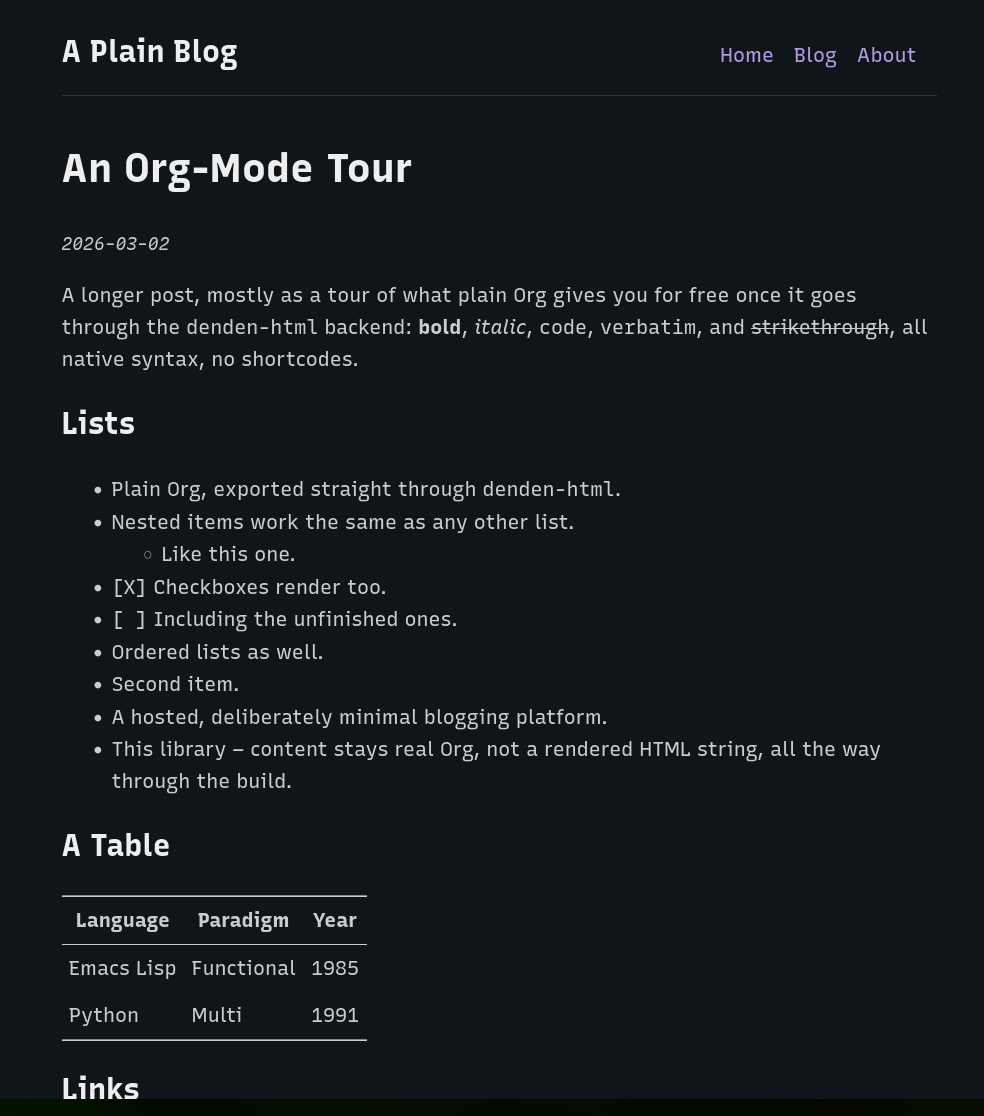
<a href="https://github.com/idlip/denden/tree/master/example">denden bearblog example site</a>. There's a small, complete example site in the repo <code>example/</code> directory, a Bear-Blog-style site with a home page, an about page, a blog listing and a couple of posts, one stylesheet, no JavaScript. You can build and serve it yourself with one command, <code>just example-build</code> or <code>just example-serve</code> from inside <code>denden/</code>, and poke around the two small files that make it tick, <code>example-site.el</code> and <code>example-theme.el</code>, to see the whole pattern in one sitting, before you even think about pointing it at your own content.
</p>


<div id="orga78ea09" class="figure">
<p><img src="https://raw.githubusercontent.com/idlip/denden/refs/heads/master/example/screenshot.png" alt="screenshot.png" />
</p>
<p>Snap of a example bearblog like site built with denden</p>
</div>
</div>
</div>
<div id="outline-container-about-the-name" class="outline-2">
<h2 id="about-the-name">About the name<a class="heading-anchor" href="#about-the-name" aria-label="Link to this section">#</a></h2>
<div class="outline-text-2" id="text-org6954538">
<p>
A <code>denden mushi</code> is the snail-shaped transponder phone from One Piece, the way everyone in that world
talks to each other across the sea. If you've looked around this site even a little, the One Piece
theme is not exactly subtle here. A static site generator's job is carrying your words from your Org
files out to the rest of the world, felt fitting enough that I didn't look for a second name,
although I did consider "dennow" to mimic "Then &amp; Now", alas something had to stay.
</p>

<p>
Give it a spin, and if you build something with it, I'd genuinely like to hear about it.
</p>
</div>
</div>
]]></content></entry></feed>